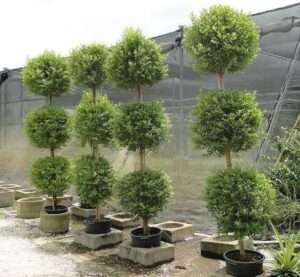
Our large eugenia 3-ball is a show-stopping evergreen topiary trained into three stacked, rounded spheres along a single trunk. At $500, the large eugenia 3-ball is a statement piece for a front entry, pool deck, courtyard, or formal garden, and it is shaped and grown to hold up in South Louisiana’s heat and humidity.
What Is a Eugenia Topiary?
In the nursery trade, “eugenia” usually refers to brush cherry, a fast-growing evergreen shrub known botanically as Syzygium paniculatum (long sold under the older name Eugenia). It has small, glossy leaves and dense branching, which makes it ideal for clipping into crisp shapes. New growth often emerges with a reddish or bronze tint before maturing to deep green, adding a little color each time the plant flushes.
A 3-ball topiary takes years of careful training and regular shearing to develop. Buying an established large eugenia 3-ball gives you that finished look right away.
Why Choose a Large Eugenia 3-Ball?
- Instant curb appeal: a pair flanking a front door or gate creates a formal, welcoming entry.
- Year-round structure: evergreen foliage keeps its shape and color in every season.
- Fits tight spaces: the vertical form adds height without taking up much ground space.
- Works in pots or beds: grows well in large containers on patios or planted in the landscape.
- Classic style: suits traditional, Mediterranean, and modern homes alike.
Where to Place Your Topiary
Light
Give it full sun to part shade. Several hours of direct sun keep growth dense and the balls full. In heavy shade, branches thin out and the shapes lose definition.
Containers
Many customers keep their topiary in a large decorative pot. Choose a container with drainage holes that is wide and heavy enough to keep the plant from tipping in wind. A high-quality potting mix that drains well is essential.
In the ground
If planting in a bed, pick a spot with well-drained soil. Avoid low areas where water collects after storms, since standing water can damage the roots.
How to Plant
- Prepare the hole or pot. Dig a hole about twice as wide as the root ball and the same depth, or choose a container a few inches wider than the nursery pot.
- Set the plant level. Keep the top of the root ball even with the surrounding soil or slightly above it.
- Backfill and stake if needed. Firm the soil gently. In windy, open sites, a discreet stake can steady the trunk while roots establish.
- Water deeply. Soak the root ball thoroughly after planting.
- Mulch. In beds, a layer of mulch helps hold moisture; keep it a few inches away from the trunk.
Watering and Feeding
Eugenia prefers consistent moisture. Water when the top inch or two of soil feels dry, and do not let a container plant dry out completely, especially in summer. Containers in full sun may need water several times a week or even daily during hot spells. At the same time, avoid soggy soil; good drainage is critical.
Feed during the growing season with a balanced slow-release fertilizer for shrubs, following the label. Regular feeding supports the steady new growth that keeps the topiary dense after each trim.
Pruning to Keep the Shape
Shearing is what keeps a 3-ball looking sharp. Eugenia grows quickly in warm weather, so plan to trim lightly several times during the growing season.
- Use sharp hand shears for the cleanest finish on rounded shapes.
- Trim new growth back to the outline of each ball rather than cutting deep into old wood.
- Keep the trunk clean by removing shoots that sprout along the stem between the balls.
- Step back often to check the shape from several angles as you work.
- Avoid heavy pruning right before cold weather, since tender new growth is more easily damaged by frost.
Protecting Eugenia in Winter
Eugenia is a subtropical plant and can be damaged by hard freezes. South Louisiana winters are usually mild, but a few nights below freezing occur in many years. When a hard freeze is forecast:
- Move container plants into a garage, shed, or covered porch.
- Water the soil a day before the freeze; moist soil holds heat better than dry soil.
- Cover in-ground plants with frost cloth or an old sheet that reaches the ground, and remove it once temperatures rise.
- Avoid plastic directly against the leaves.
If some leaves brown after a cold snap, wait until spring to trim damaged growth so you can see what recovered.
Common Problems
Thin or bare spots
Usually caused by too little sun or skipped feeding. Move the plant to a brighter location and feed during the growing season; light shearing encourages branching to fill gaps.
Leaf drop
Often a sign of drought stress, root damage from waterlogged soil, or cold injury. Check soil moisture and drainage first.
Pitted or curled new leaves
Small sap-feeding insects, including a psyllid that targets eugenia in some regions, can cause bumpy or distorted new leaves. Trim affected growth and ask us about treatment options before spraying.
Styling Ideas for a Large Eugenia 3-Ball
Because of its height and strong geometric shape, a large eugenia 3-ball works best where it can be seen as a focal point. Some placements our customers like:
- Front door pair: one large eugenia 3-ball on each side of the entry, in matching pots, frames the door and makes the house feel finished.
- Gate or driveway entrance: mark the start of a walkway or drive with a pair set in beds or planters.
- Pool deck: evergreen topiaries add structure around a pool without dropping lots of leaves into the water.
- End of a path: a single large eugenia 3-ball at the end of a garden path draws the eye forward.
- Corner accent: soften the corner of a patio or the edge of a house with a tall vertical shape.
Underplant the pot or bed with low flowers or a ground cover for seasonal color at the base, keeping roots of companion plants from crowding the topiary.
Caring for a Large Eugenia 3-Ball in a Container
Containers give you flexibility, but they also dry out and heat up faster than the ground. For a potted large eugenia 3-ball, check soil moisture often in summer, use a saucer only if you empty it after rain so roots never sit in water, and refresh the top layer of potting mix each spring. Every few years, when roots begin to circle the pot, move the plant into a slightly larger container. A heavy pot or a few bricks in the bottom helps keep the tall topiary stable during summer storms.
The First 30 Days After Planting
The first month is when your new large eugenia 3-ball settles into its new home. Water deeply right after planting, then check every day or two during warm weather. Hold off on heavy pruning for a few weeks so the plant can focus on new roots; a light touch-up of stray shoots is fine. Some yellow leaves may drop as the plant adjusts to a new spot, which is normal. Once you see fresh growth, begin regular feeding and your normal trimming routine.
Pair It With Other Formal Plants
A large eugenia 3-ball pairs naturally with other clipped evergreens. Use it as the centerpiece of a bed edged with low boxwood, or add our smaller eugenia shapes for a matching collection.
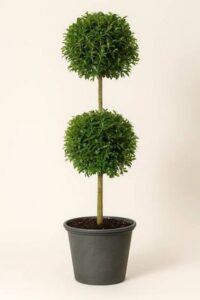


See our dwarf eugenia 3-ball and dwarf eugenia 2-ball for smaller spaces, plus Sprinter boxwood and Faulkner boxwood for borders. Browse all trees, or read about brush cherry (Syzygium paniculatum) on Wikipedia.
Large Eugenia 3-Ball Price, Delivery, and Pickup
The large eugenia 3-ball is $500. Because this is a large plant, delivery to Slidell and New Orleans is quoted by text after you order, based on size and location. We confirm availability and your delivery details before your card is charged.
- Delivery: large-plant delivery is quoted by text for Slidell and New Orleans ZIP codes.
- Free pickup: 1605 Lawes St, Slidell, LA 70461. Bring a vehicle large enough to transport a tall topiary upright or on its side with care.
- Questions: call or text 504-475-8084.
Eugenia Topiary FAQ
How often do I need to trim a eugenia topiary?
During warm months, light trimming every several weeks keeps the shape crisp. Growth slows in winter, so little trimming is needed then.
Can it stay outside all year?
Usually, in South Louisiana, as long as you protect it from hard freezes.
Will it grow larger?
Yes. The balls will slowly get bigger unless you trim them back to the same outline each time.
How tall is the large eugenia 3-ball?
Sizes vary from plant to plant as each one is trained by hand. Call or text us for the current height and pot size of the plants in stock, and we can send photos before you order.
Is it hard to maintain?
Not if you trim regularly. Light, frequent shearing is easier than occasional heavy cuts.
Should I buy two?
A matching pair is a popular choice for flanking a doorway, gate, or garage. Ask us about availability of matched plants.